Nitrile glove sizing: how to measure your hand and read S–XXL
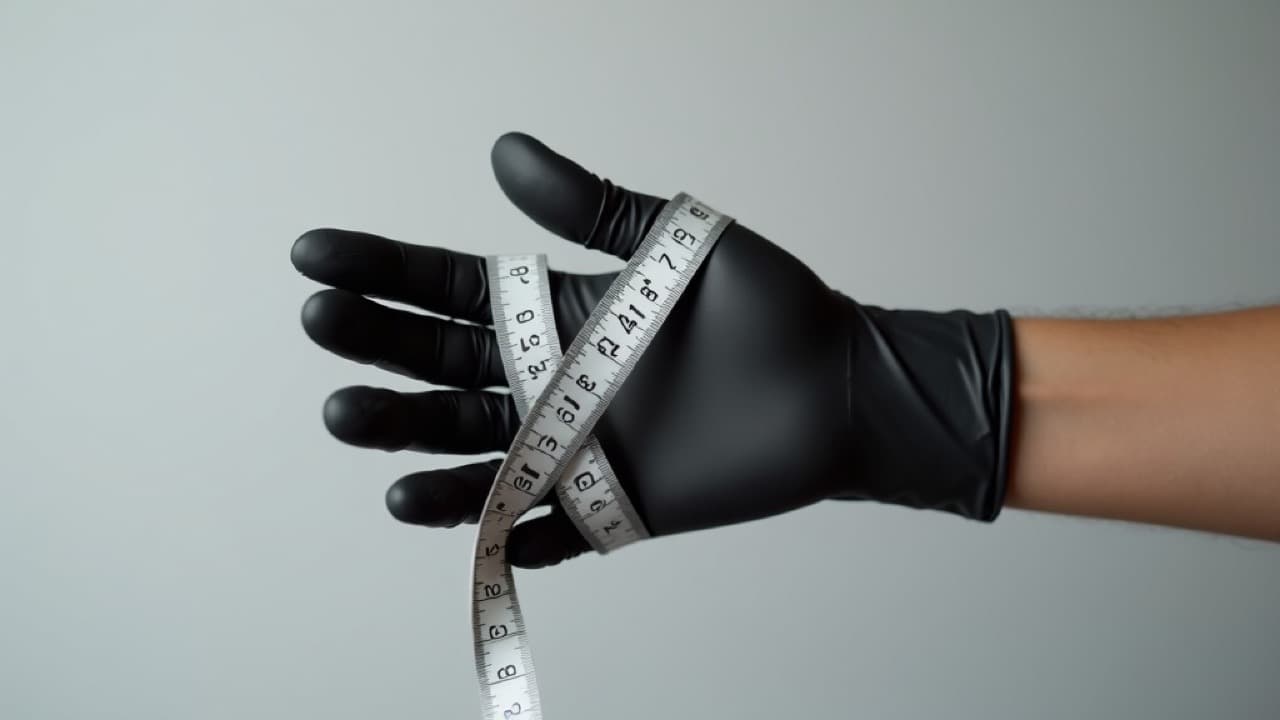
XL in nitrile gloves means a palm circumference of 22–24 cm, size 10 on the GOST numeric scale. L is 20–22 cm (nine), M is 18–20 cm (eight), S is 16–18 cm (seven). One tape around the palm, one number in centimetres, and the letter on the pack stops being a lottery
The letter on the pack is a conversion of palm circumference and nothing more is hidden behind it. The number printed next to it (6, 7, 8, 9, 10, 11) equals hand circumference in inches: eight is eight inches, roughly 20 cm, and on the pack it says M. Below: the full S–XXL chart, a one-minute measurement, a separate look at women's sizes and at the borderline cases
Nitrile glove size chart: S, M, L, XL, XXL
The size range is the same across the whole industry: six numbers, six letters. The leading parameter is palm circumference at the base of the fingers. Hand length is the cross-check, and it earns its keep when the circumference lands exactly between two sizes
| Size | Numeric size (GOST) | Palm circumference, cm | Hand length, cm |
|---|---|---|---|
| XS | 6 | 14–16 | 16.0 |
| S | 7 | 16–18 | 17.1 |
| M | 8 | 18–20 | 18.2 |
| L | 9 | 20–22 | 19.2 |
| XL | 10 | 22–24 | 20.4 |
| XXL | 11 | 24–26 | 21.5 |
Hand length in the right-hand column is the minimum under ISO 21420, the standard the Russian GOST is harmonised with. It is measured from the tip of the middle finger to the wrist line. If the circumference pulls you towards two neighbouring sizes, the length says which one is yours
The letters in plain language:
- XS (6) — a child's hand and a very narrow female one
- S (7) — a narrow female hand, a teenager, precision work
- M (8) — the best seller: most female hands and average male ones
- L (9) — an average to large male palm
- XL (10) — a large male hand, broad palm, manual trades
- XXL (11) — a very large hand, a rare order, but a crew cannot be covered without it
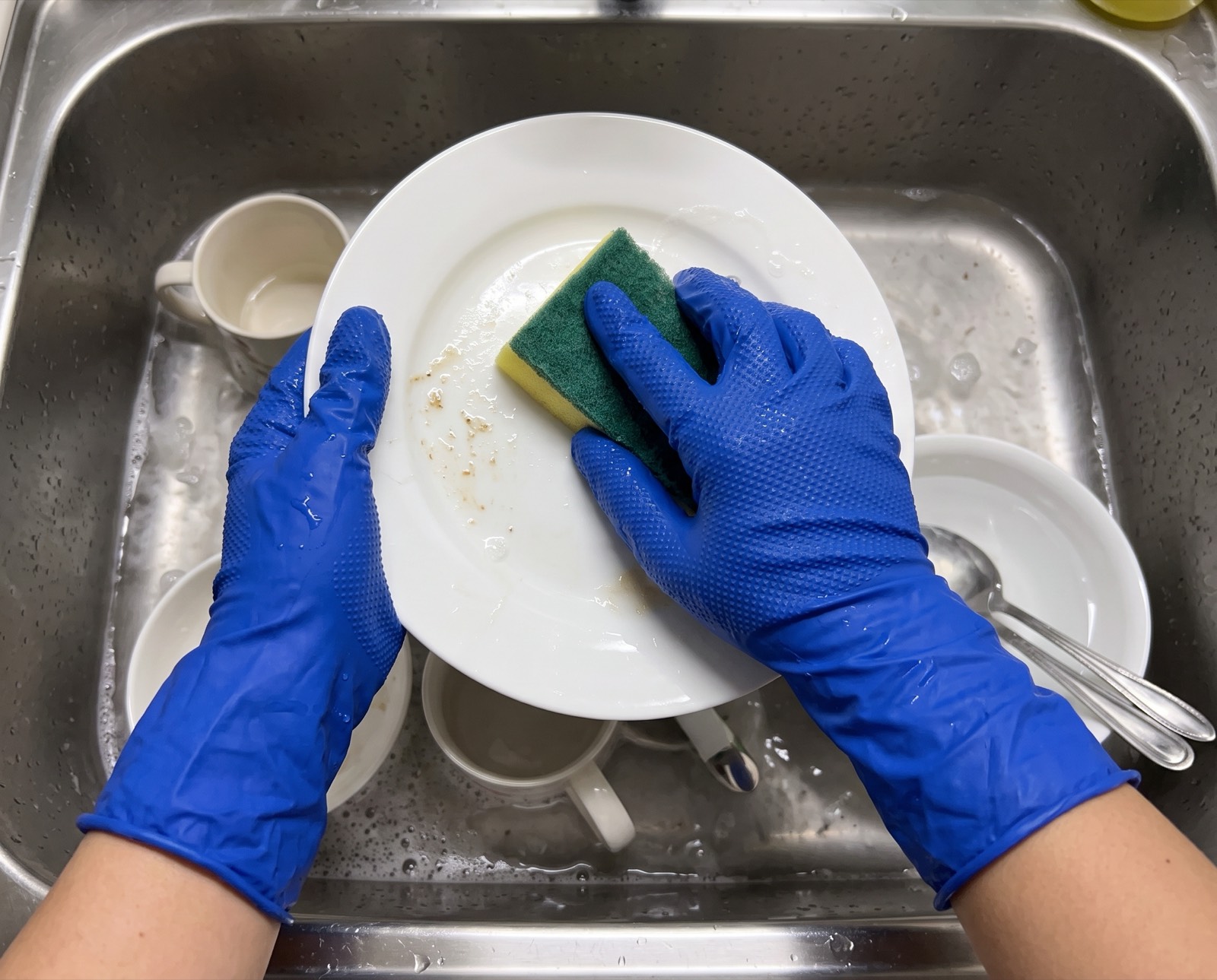
That is what a correct fit looks like: the glove hugs the palm without folds at the fingers and does not squeeze the wrist. That fit comes from the right circumference, and a letter picked at random will not guarantee it
Find your size in ten seconds
Measure your palm as shown in the diagram and enter the number — the calculator returns the letter, the GOST number and tells you what to do if you land between two sizes. What to measure with when there is no tape at home comes in the next section
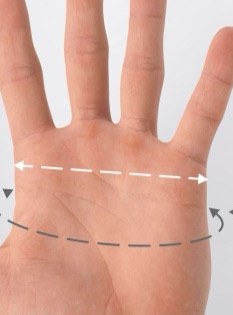
- Wrap the tape around your palm at the base of the fingers — along the dashed line on the diagram
- Leave the thumb out
- Measure your working hand: for right-handers the right one is usually slightly larger
How do I measure my hand in a minute?
Take a tape measure, or a piece of thread and a ruler, and wrap it around your palm at its widest point, at the base of the fingers. The number in centimetres is your circumference, and that is what the size is built on. It takes a minute, and no fitting is needed. Measure your working hand: for right-handers the right one is usually slightly larger
- Wrap the tape around the palm at its widest point, at the base of the fingers
- Leave the thumb out — it is not enclosed
- Write down the number in centimetres. That circumference is what sets your size
Circumference is the key parameter for a disposable glove: it decides whether the glove sits without folds and whether it survives the first hard grip
What to measure with when you have no tape
A tailor's tape is rare in most homes, and the size is needed now. Any flexible strip that you can later hold against a ruler will do:
- A strip of paper — cut a two-centimetre band off an A4 sheet, wrap it around the palm, mark the overlap with a pen and unroll it
- Thread, a hoodie drawstring, a charging cable — wrap it, pinch the overlap, hold it against a ruler
- A steel tape from the toolbox — stiff, but it still measures the palm if you press it to the skin
Half a centimetre of accuracy is enough: the size steps are two centimetres apart, so being three millimetres out never changes the letter. There is only one way to get it truly wrong — to measure width instead of circumference. Width is roughly half of the circumference: for M it is 9–10 cm. If your number came out around ten, you measured the wrong thing
Glove sizes for women: the chart and what sells most
"What is the women's glove size" is one of the most frequent questions, and the honest answer is a spread of two or three letters. A female hand is on average two to three centimetres narrower in circumference, so the bulk of demand falls on S and M
| Hand | Palm circumference | Size | Where it shows up most |
|---|---|---|---|
| Narrow female | 16–18 cm | S (7) | manicure, cosmetology, fine detail |
| Average female | 18–20 cm | M (8) | cleaning, kitchen, hair colouring, home |
| Broad female | 20–22 cm | L (9) | contract cleaning, long shifts, tool work |
| Teenager, 12–15 years | 15–18 cm | XS–S (6–7) | helping around the house, the garden |
Disposable gloves have no separate women's range: the same six letters, the same centimetres. The only difference is which part of the range moves faster. In nail salons the S and M packs run out first, while L sits on the shelf for months
"Most often" is the key phrase here. A technician with a broad palm ends up in a solid L, a slightly built man in M. Sex sets the probability; only the tape sets the size
Men's sizes for comparison
| Hand | Palm circumference | Size |
|---|---|---|
| Narrow male | 18–20 cm | M (8) |
| Average male | 20–22 cm | L (9) |
| Large male | 22–24 cm | XL (10) |
| Very large | 24 cm and above | XXL (11) |
Why letters drift between brands and centimetres do not
The SafeGrip size chart is built on the numeric GOST system and tied to palm circumference — the same figures are printed on the pack and shown on the product page
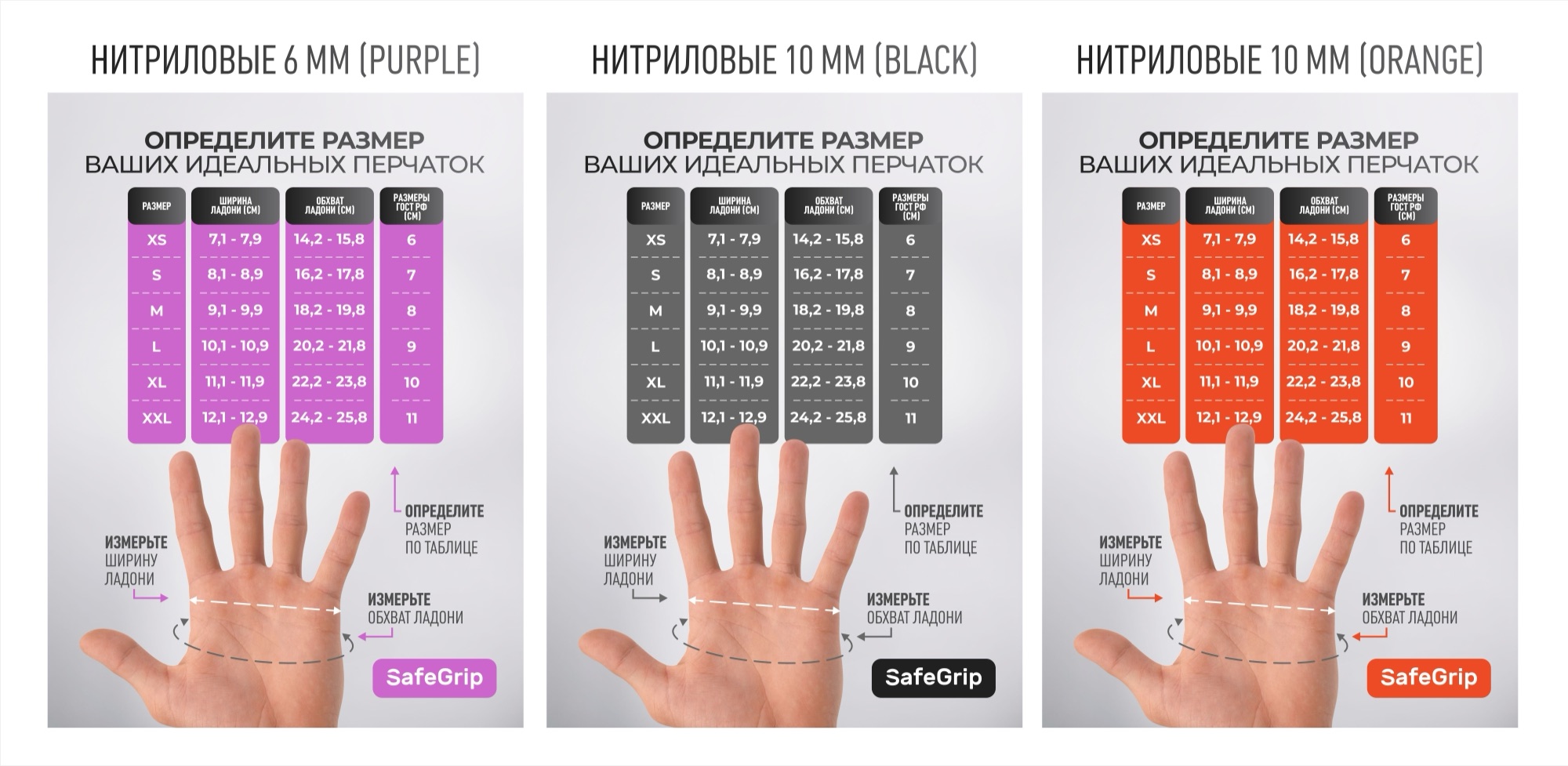 SafeGrip nitrile glove size chart: palm width and circumference, GOST numeric sizes for 6 and 10 mil nitrile
Formers differ between factories, so two gloves labelled the same "M" will sit differently: the circumference behind one letter drifts by one or two centimetres. This is not a defect, just different moulds for dipping. The correct order is this: measure the hand first, then read the chart of that specific product, and only last of all recall the letter you are used to from someone else's box
If your circumference falls on a border, take the larger size for long work and the smaller one where tactile feel matters, manicure being the obvious case
The most common mistake is picking the size you wear in fabric work gloves. Disposable nitrile stretches and moulds to the hand, so the allowance you are used to works against you here: the extra centimetre turns into folds that catch on tools
The same size, but not in every line
The size range of a disposable glove depends on the thickness of the model, not only on the brand. Thin and heavy-duty lines are made on different formers, and the extreme sizes are not available everywhere. For SafeGrip it looks like this:
| Line | Thickness | Sizes available | Typical use |
|---|---|---|---|
| 6 mil | 0.15 mm | S, M, L | household jobs, cleaning, kitchen, manicure |
| 10 mil | 0.25 mm | S, M, L, XL, XXL | repairs, car service, construction, chemicals |
| 11 mil LONG | 0.28 mm | M, L, XL | the heaviest work, wrist protection |
The practical takeaway: with a 23 cm palm the thin 6 mil line is simply out of reach, because its range ends at L. The other way round, at 17 cm the heavy 11 mil will be loose, because its range starts at M. Before choosing colour and pack size, check that your size exists in the thickness you need
Why glove weight grows with size
Weight per glove is a good marker of an honest size range. If the maker really dips different formers, XL is physically heavier than S: a bigger hand takes more material. Across the SafeGrip range the difference is visible
| Size | 6 mil, g | 10 mil LONG, g | 11 mil LONG, g |
|---|---|---|---|
| S | 6.5 | 7.4 | — |
| M | 7.0 | 8.0 | 12.0 |
| L | 7.5 | 8.8 | 13.2 |
| XL | — | 9.3 | 14.4 |
| XXL | — | 10.0 | — |
Treat this as a way to check the seller. When a listing shows one weight for the whole S–XXL range, it means one of two things: either the figure is an average that matches no actual glove, or every size comes off the same former and only the letters on the packs differ. The second case is what produces gloves where L and M feel identical on the hand
Open the product specification and look for the weight of one glove. If it is listed per size and grows from S to XL, the size range is real. If there is a single figure for all sizes, or no weight at all, do not trust the chart — go by what reviews say about the fit
What the standard says: glove sizes by the book
The glove size range in Russia is not invented by brands — it is fixed in a standard. Protective and work gloves, which is what SafeGrip nitrile gloves are, fall under GOST 12.4.252-2013 "Occupational safety standards system. Personal protective equipment for hands. Gloves. General technical requirements. Test methods". It is harmonised with the international standard ISO 21420:2020 (formerly EN 420) and sets a single range of 6, 7, 8, 9, 10, 11, with a letter XS–XXL for each number
The essentials:
- Two parameters define the size — hand circumference and hand length. Circumference leads
- The numeric size ≈ hand circumference in inches — size 7 is a hand about 7 inches around (≈17.8 cm), size 8 is about 8 inches, and so on. That is why the "numeric size" column in the chart above is a normative designation taken from the standard
- How the standard measures — with a flexible tape 20 mm away from the fork between thumb and index finger, thumb excluded. It is the same measurement described above, just with an exact starting point
One subtlety that rarely gets written down: the standard governs the numbers, and the letters S–XL are not rigidly tied to them. A manufacturer is free to call size 8 either "M" or "L", and nothing in the standard forbids it. So the only genuinely universal reference is centimetres of circumference. The letter belongs to the brand, the centimetres are the same for everyone
If a glove is sold as an examination (medical) glove, a different document governs its sizes — GOST ISO 11193-1 for nitrile and latex examination gloves. The size range is the same (XS–XL), but the requirements for the product itself are stricter. For household and work tasks, GOST 12.4.252-2013 is the reference
Choosing a size for the task
Circumference gives you the letter. What you actually do in the gloves decides the rest: somewhere tactile feel matters more, somewhere it is about the hand surviving a full shift
| Task | What matters | On the border take |
|---|---|---|
| Manicure, cosmetology, tattoo | tactile feel, no folds | the smaller size |
| Food handling, kitchen | finger mobility, quick changes | exactly by measurement |
| Cleaning with household chemicals | tight cuff, nothing seeps in | exactly by measurement |
| Repairs, painting, filling | long wear, hand does not tire | the larger size |
| Car service, construction | strength, no tearing in the finger web | the larger size |
| Shifts of 8 hours and more, frequent changes | easy to pull onto a damp hand | the larger size |
The logic is simple: the longer the glove stays on, the more a tight fit costs you; the finer the operation, the more an extra millimetre of material under the fingers costs you. With nitrile, tactile feel also depends on the palm texture — we cover how that works in the piece on grip and texture
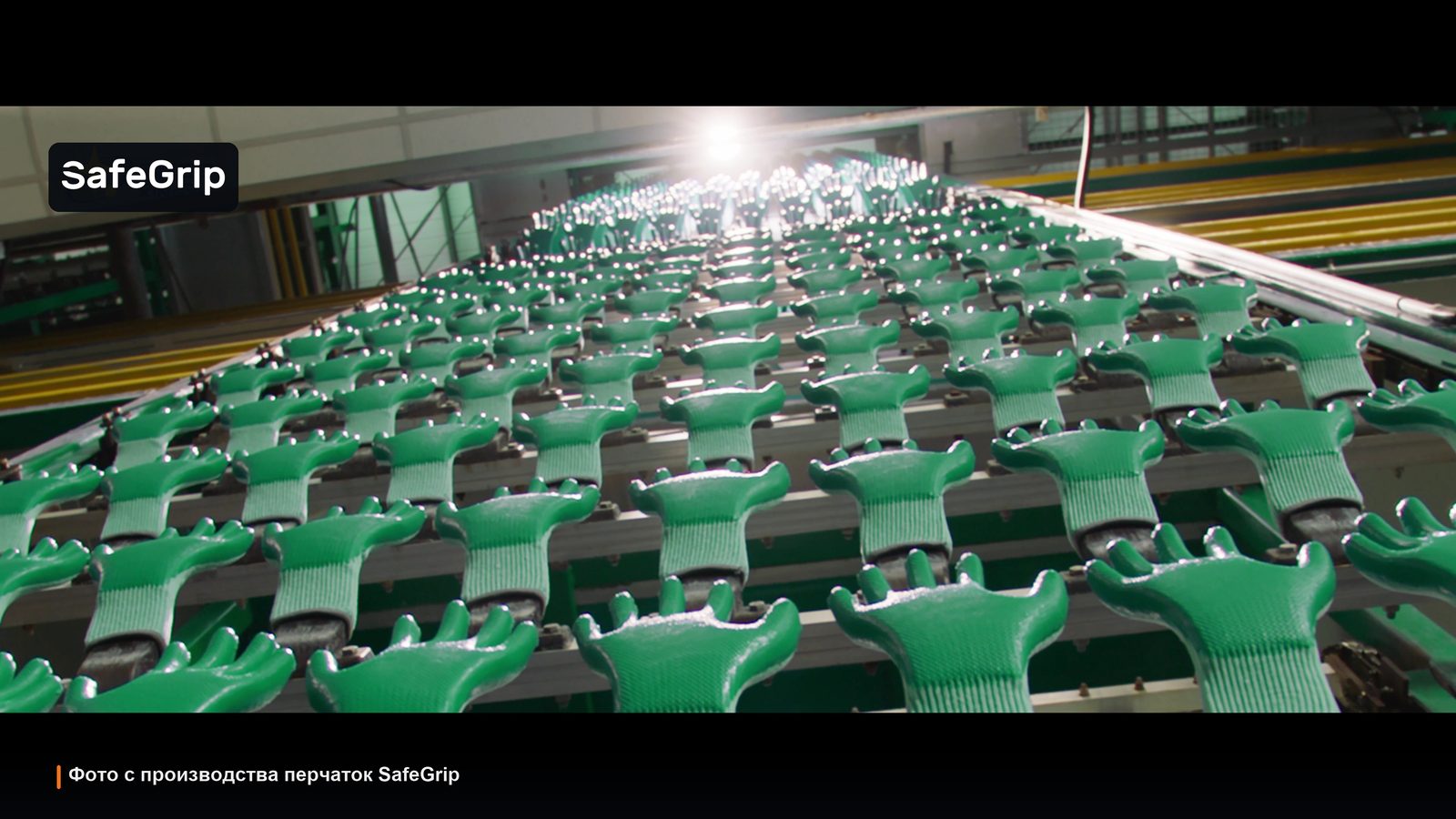 Glove production line at SafeGrip
The letter on the pack is the maker's promise. The centimetres on your tape are a fact
Six signs the size is wrong
Half an hour of work tells you everything. Signs the glove is too tight:
- It tears in the web at the base of the thumb — the most stretched spot gives way first
- The material whitens and clouds over the knuckles — the nitrile is stretched to its limit and is already losing strength
- The hand tires and fingertips go numb — the glove works like a tourniquet
- The glove slides off the fingers when you bend them — it is short in length even if the circumference is right
And signs it is too large:
- Folds of material under the fingertips — tools catch on them and precision is gone
- Empty fingertips, a "beak" — you cannot feel the object, and the glove pulls off along with it
There is a separate case: the glove fits well and still wears out fast. Then it is about thickness or replacement frequency — when to change a pair is a topic of its own
How does thickness affect the size choice?
The thicker the glove, the more a sizing error costs. A thin model stretches a little and forgives half a size; a heavy one does not — it is stiffer and splits sooner in the finger webs on a tight hand. If you work in heavy gloves, measure more carefully
There is a reverse effect people forget: thick nitrile transmits less feel, so on the border many instinctively take the smaller size to "feel the tool". In 10–11 mil that is a mistake — you will not get the tactile feel back and you will lose glove life. How to choose the thickness itself is covered in the piece on mils and millimetres
What to do if the size turned out wrong
The pack is open and the gloves pinch or flap. What genuinely helps:
- Half a size too small — fine for short operations where the glove is on for 10–15 minutes. Do not use them for a shift: they will split in the finger web
- Half a size too large — use them where precision is not needed: mixing, carrying, cleaning, work with large tools
- A full size too large or more — useless for fine work, but handy as the outer pair in double gloving over a thin glove, which is how people handle aggressive chemicals and resins
- Tight at the wrist but fine across the palm — the model probably has a short cuff. Look at the LONG line: a 290–300 mm cuff covers the wrist without squeezing it
Do not throw the pack away. Just make it a rule to measure the circumference before ordering: gloves are a consumable, and hand size does not change for years. One measurement settles the question for good
How many of each size to order for a crew
For a team purchase the question is different: in what proportion to buy the sizes. There is no universal table here — the make-up of a crew in a nail salon and on a finishing site differ far too much. What works is a different sequence:
- Measure the crew once — a round of ten people with a tape takes fifteen minutes and settles the question for a year. Write the numbers into the same file where you keep the roster
- Group them by letter and you have your own size mix, rather than an industry average
- Skew towards the larger size — a glove one size up survives the shift, a glove one size down tears and burns through stock twice as fast
- Correct after the second order — see which packs ran out first. Consumption, not the initial measurement, shows the real demand
- Keep a buffer of the extreme sizes — S and XL move more slowly, and they are exactly the ones missing when a new person joins
Check that the size you need exists in the chosen thickness: the thin 6 mil line ends at L, and 11 mil starts at M. Covering a whole crew from a single thickness is not always possible — sometimes two lines for different tasks is the better answer
How to calculate volume and what to look at when buying disposable gloves in bulk is covered in the piece on wholesale glove purchasing
A short checklist before ordering
- Measure the palm circumference of your working hand — at the base of the fingers, thumb excluded
- Turn the centimetres into a letter using the chart: 16–18 is S, 18–20 is M, 20–22 is L, 22–24 is XL
- Find the size chart of that specific product; do not use a general table from another site
- Check that your size exists in the thickness you need: 6 mil runs S–L, 10 mil S–XXL, 11 mil M–XL
- Look at the per-size weight: if it grows from S to XL, the chart is real
- On the border choose by task: allowance for long work, a tight fit for precision operations
Nitrile gloves in the thickness and pack size you need are in the SafeGrip catalogue, where every model carries its own size chart. For the most demanding jobs see 10 mil nitrile gloves: the same S–XL chart, walls two and a half times thicker
Sources
- GOST 12.4.252-2013 "Occupational safety standards system. Personal protective equipment for hands. Gloves. General technical requirements. Test methods" — the Russian standard in force for sizes and measurement of protective gloves (range 6–11, method of measuring hand circumference)
- ISO 21420:2020 "Protective gloves — General requirements and test methods" — the international standard that GOST 12.4.252-2013 is harmonised with; it defines sizes 6–13 by hand circumference and minimum hand length, and replaced the former EN 420:2003+A1:2009
- GOST ISO 11193-1 — the standard for nitrile and latex examination (medical) gloves, where a glove belongs to that category
- Size ranges, per-size glove weights and size availability across the 6, 10 and 11 mil lines — SafeGrip product pages and the assortment register of OOO Bestbuyer, data as of August 2026
Frequently asked questions
Glove sizes S, M, L, XL, XXL explained
Each letter converts into a palm circumference and a numeric size under GOST: XS is 14–16 cm (number 6), S is 16–18 cm (7), M is 18–20 cm (8), L is 20–22 cm (9), XL is 22–24 cm (10), XXL is 24–26 cm (11). The number equals hand circumference in inches, which is why eight is M
What size is XL in gloves
XL is a palm circumference of 22–24 cm, size 10 on the GOST numeric scale. That is a large male hand. The neighbouring sizes are L at 20–22 cm and XXL at 24–26 cm
Nitrile gloves size XL — what hand is it for
For a palm measuring 22–24 cm around at the base of the fingers, with a hand length of about 20.4 cm. Most often that is a man's hand in a manual trade. SafeGrip offers XL in the 10 mil and 11 mil LONG lines; in the thin 6 mil line the range ends at L
Nitrile glove sizes — how do I find mine
Wrap a tape measure around the palm of your working hand at the base of the fingers, leaving the thumb out. Find the number in centimetres in the chart: 16–18 cm is S, 18–20 is M, 20–22 is L, 22–24 is XL. Circumference matters more than hand length, and more than the letter you are used to from someone else's box
Glove size chart for women
A narrow female hand measures 16–18 cm around — size S (7). An average one is 18–20 cm, size M (8), which is also the best seller. A broad female palm is 20–22 cm, size L (9). Disposable gloves have no separate women's range: the same letters, the same centimetres
On the border between two sizes — up or down
It depends on the job. For a long shift take the larger size so your hand tires less. For precision work such as manicure take the smaller one to keep tactile feel and avoid folds
What can I measure with if I have no tape measure
Wrap a strip of paper, a thread, a shoelace or a charging cable around your palm, mark where it meets and hold that length against a ruler. Half a centimetre of accuracy is enough — the size steps are 2 cm apart
Why does the same size fit differently across brands
Formers differ from factory to factory, so go by the size chart of the specific product rather than by the letter S–XL alone
The glove tears near the thumb — is that size or a defect
Usually size. The web at the base of the thumb stretches the most and gives way first on a tight glove. If gloves from different packs keep tearing in the same spot, go one size up. If the tears are scattered all over the glove, that is a question about the batch quality
The SafeGrip team works through glove materials, standards and biomechanics from primary sources — EN/ASTM standards and peer-reviewed research.